

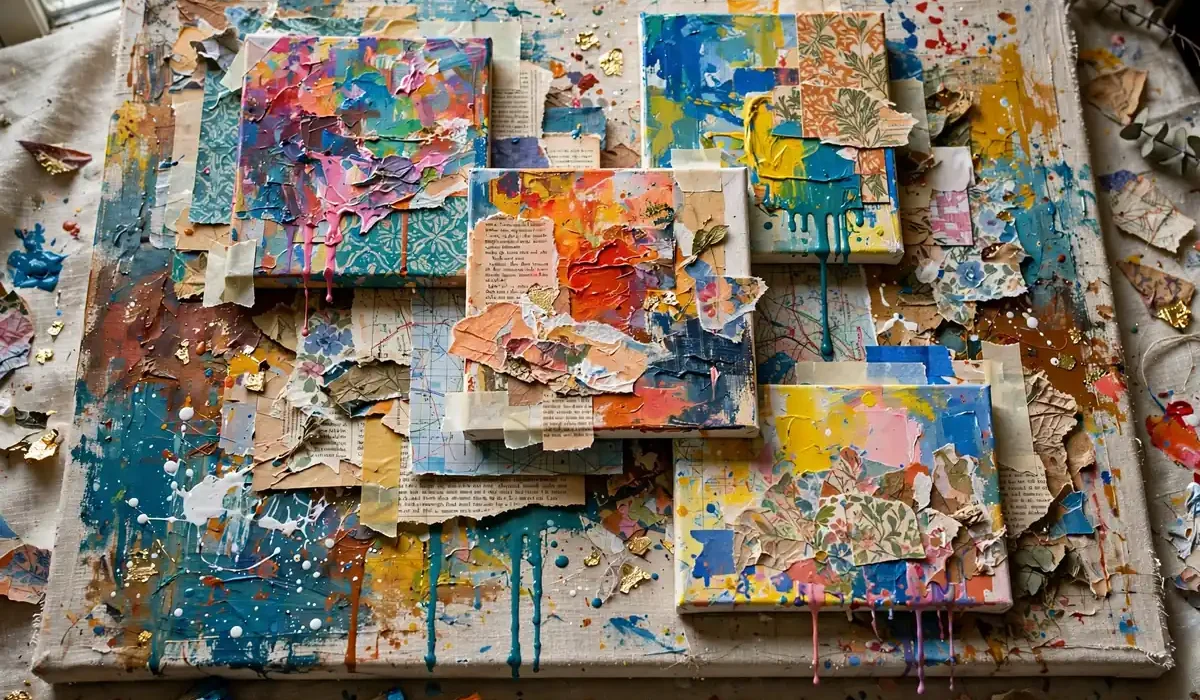
Most paintings live on a single flat surface. Canvas on canvas art breaks that rule. In this technique, you layer smaller canvases, panels, and collage pieces on top of a larger base canvas to create art with real depth, shadow, and texture. The result feels sculptural, modern, and wonderfully tactile. This guide focuses on the LAYERED canvas on canvas technique. You will learn how to plan a composition, build up texture, combine paint and collage, attach layers securely, and finish a piece that looks like it belongs in a gallery. You do not need advanced painting skills.
What Is Canvas On Canvas Art?
Canvas on canvas art is mixed media artwork where one or more smaller canvases are mounted onto a larger canvas. The base canvas acts as the background and the stage. The smaller canvases act as raised panels, windows, or islands of color and pattern. Artists often add paint, paper, fabric, texture paste, stamps, and found objects between the layers. Because the layers create real shadows, the work feels alive in a way that flat painting cannot match.
Supplies for Canvas On Canvas Art
Start with one large base canvas, such as 16 by 20 inches. Then gather several smaller canvases and canvas panels in mixed sizes, such as 4 by 4, 5 by 7, and 6 by 8 inches. Flat panels are easier to attach than thick stretched canvases, but both work. Acrylic paint is the best choice because it dries fast and bonds well. Gather a limited palette of three to five colors plus black and white so your piece stays cohesive. You will also want acrylic gel medium for gluing and texture, texture paste for raised effects, and gesso for priming. For collage, collect old book pages, maps, tissue paper, fabric scraps, and lace, plus palette knives, sponges, and stencils.
Planning Your Layered Composition
A strong layered piece starts with a simple idea: a color story like ocean blues and sandy neutrals, or a theme like travel, nature, music, or city life. Pick one idea and let it guide every layer. Before you glue anything, arrange your small canvases on the base canvas and photograph several options. Try a grid, an off-center cluster, a diagonal line, or one large focal panel with smaller pieces around it. Leave some base canvas visible. Negative space gives the eye a place to rest and makes the layers feel intentional. Every strong composition needs a focal point, one area that draws the eye first. Make it the most detailed, most contrasted, or most colorful layer — a small canvas with a painted flower, a bold word, or a portrait. Keep other layers simpler so the focal point stays special.
Building Layers: Step by Step
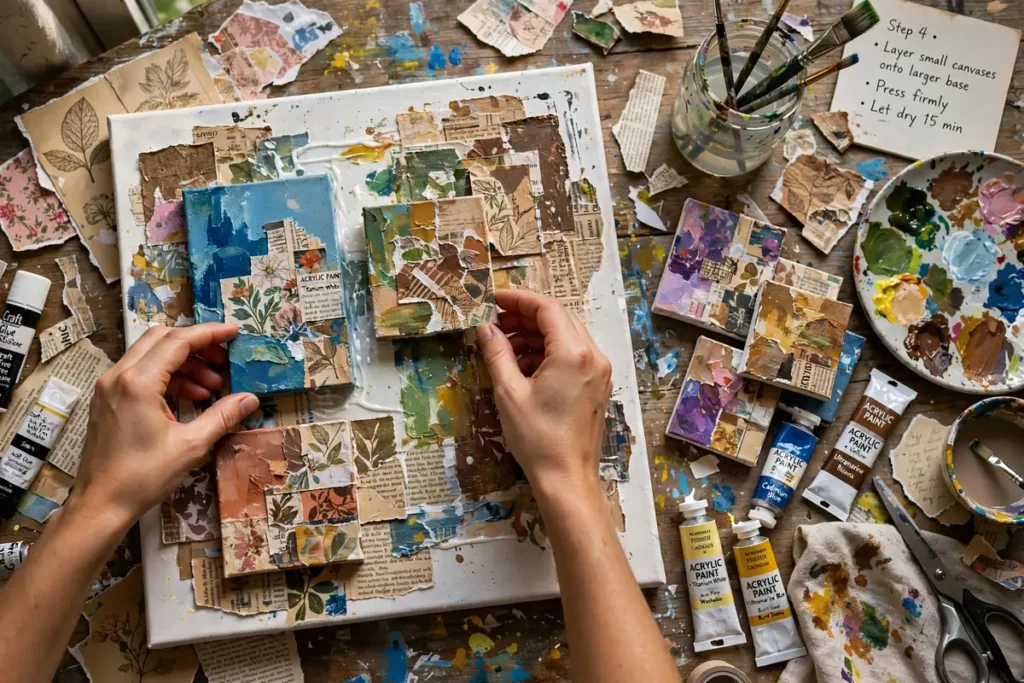
First, prime the base canvas with gesso if it feels slick, and paint a background wash. This background will peek out between layers, so choose a color that supports your palette. Let it dry fully. Next, paint each small canvas separately. Vary the treatments: bold brushstrokes on one, collage paper on another, a stenciled pattern on a third, and a single simple shape on the last. Let every piece dry before you move on. While the small canvases dry, add texture to the base canvas. Apply texture paste through a stencil, press fabric or lace into wet gel medium, or scrape paint with a palette knife. Then place your small canvases on the base again and adjust until the arrangement feels balanced. Attach each piece with a generous layer of gel medium or strong craft glue. Press firmly, wipe away excess adhesive, and weigh pieces down with books while they dry. For thicker canvases, you may need small screws or brackets from behind for extra security. Once the layers are attached, unify the piece. Paint over the edges where small canvases meet the base, add small collage pieces that bridge two layers, or draw lines that continue across layers. Use a unifying color, a repeated shape, or a thin line of gold or black to tie everything together. Step back and look for empty spots or areas that need contrast. When you are happy, seal the whole artwork with a clear acrylic varnish in matte or gloss.
Creative Ideas and Tips
Try a travel memory piece with a map background, small canvases painted with landmarks, and ticket stubs tucked between layers. Make a nature piece with botanical prints and pressed leaves sealed under gel medium. Create an abstract piece using only shapes and color, with each small canvas exploring one color family. Or make a word art piece where each small canvas carries one letter or one word, building a quote across the base. Limit your palette to three to five colors plus neutrals. Vary heights and textures: smooth painted areas with rough texture paste, matte paper with glossy gel, flat shapes with raised layers. Work in stages and let layers dry. Photograph your arrangement before you glue, so you can rebuild it if a piece shifts. Avoid gluing too early, using too many competing patterns, or adding heavy objects without support.
FAQ
What glue works best for canvas on canvas art?
Acrylic gel medium is the best all-round choice because it bonds, seals, and adds texture. Heavy gel medium works well for thicker pieces. For very heavy small canvases, add mechanical support like small screws or brackets from behind.
Do I need to prime canvases before painting?
Most store-bought canvases are pre-primed, but an extra coat of gesso gives a smoother surface and better paint adhesion. Prime if your canvas feels slick, or if you want a bright white base for light colors.
Can beginners make layered canvas art?
Yes. Layered canvas art is ideal for beginners because you can work on small pieces one at a time, replace any layer you dislike, and build confidence gradually. There is no single right way to layer.
How do I keep layered canvas art from looking messy?
Use a limited color palette, leave some negative space, and keep one clear focal point. Repeat one or two shapes or colors across layers to unify the piece, and stop before you overfill the base.
How do I hang heavy layered canvas art?
Use hardware rated for the finished weight. For heavy pieces, use two wall hooks or a French cleat rather than a single nail. If the piece is very heavy, hang it into a wall stud for security.
Final Thoughts
Canvas on canvas art invites you to think like a builder, not just a painter. You are stacking color, texture, and story into something you can almost reach into. Start with one base canvas, a handful of small panels, and a simple color story. Layer, step back, adjust, and seal. Gather your canvases this week and try one layered piece.